

I was reading Lucy Cooke’s Bitch (a fantastic book by the way) on the train, minding my own business, when one line made me go and spend the next 3 hours reading papers about birds.
For a long time, when female birds sang, scientists wrote it off as a hormone imbalance.
Female1 birdsong was a glitch. A female bird opening her beak to sing was treated like a malfunctioning toaster, something that had gone slightly wrong with her chemistry. The assumption was that song belongs to males, so a singing female must be broken.
I paused the audiobook. And opened up Google Scholar.
How the rabbit hole started
The name that kept coming up was Naomi Langmore, a behavioural ecologist who has spent decades on the thing nobody was supposed to find interesting: why female birds sing. I found a review that she wrote back in 1998, then a string of papers running all the way to 2023, and the more I read the more I realised this was not a small correction to the textbook. It was just wrong about half the birds. And I didn’t realise I cared about birds to much until this moment.
Male birds sing. They sing to win mates and hold territory. Song is the showy male thing apparently, the avian equivalent of a sports car, a trait sculpted by females choosing the flashiest singer. Darwin loved this idea. Song was his neat example of sexual selection doing its work, and the textbooks built on it for the next century. Catchpole and Slater’s standard definition, the one generations of students learned, called song “long, complex vocalisations produced by males in the breeding season.”
Produced by males. It is right there in the definition. The female birds were ignored from day 1… and that sounds a little too familiar to me…
So what did ornithologists actually think female song was?
An aberration. The 1998 review I found spells it out: the traditional explanation for the odd singing female was that her song was “a temporary and functionless aberration caused by abnormally high androgen levels.” Too much testosterone, basically. She wasn’t communicating. She had simply leaked some male hormone and the singing was the unfortunate side effect, like a hiccup.
I find this genuinely funny in a bleak way. A female animal does a thing. The thing looks like something males do. Rather than ask what she might be doing it for, the science of the day decided she was a male who had gone a bit wrong. You could write a whole gender studies module on that alone, and honestly someone probably has. And if they haven’t and you want me to, lemme know.
Then the data started coming in, and the data did not care for the old story.
Plot twist: most female birds sing 😮
When researchers finally went and counted properly, mapping song onto the songbird family tree, the picture flipped. Female song turned out to be present in something like 60 to 70 percent of songbird species. Not a rare malfunction. The majority.
And it gets better. Because the same work showed that female song is the ancestral state. The original songbirds sang. Both sexes did. So the interesting evolutionary question was never “why do males sing.” Males singing is the boring default. The real question, the one nobody had thought to ask, is why some females stopped.
A century of research framed female song as the puzzle, the deviation, the thing that needed explaining. It was the wrong way round the whole time. The silence was the deviation.
This is roughly the point in the evening where I started texting my friend in a state.
The north-south thing (how the map drew the science)
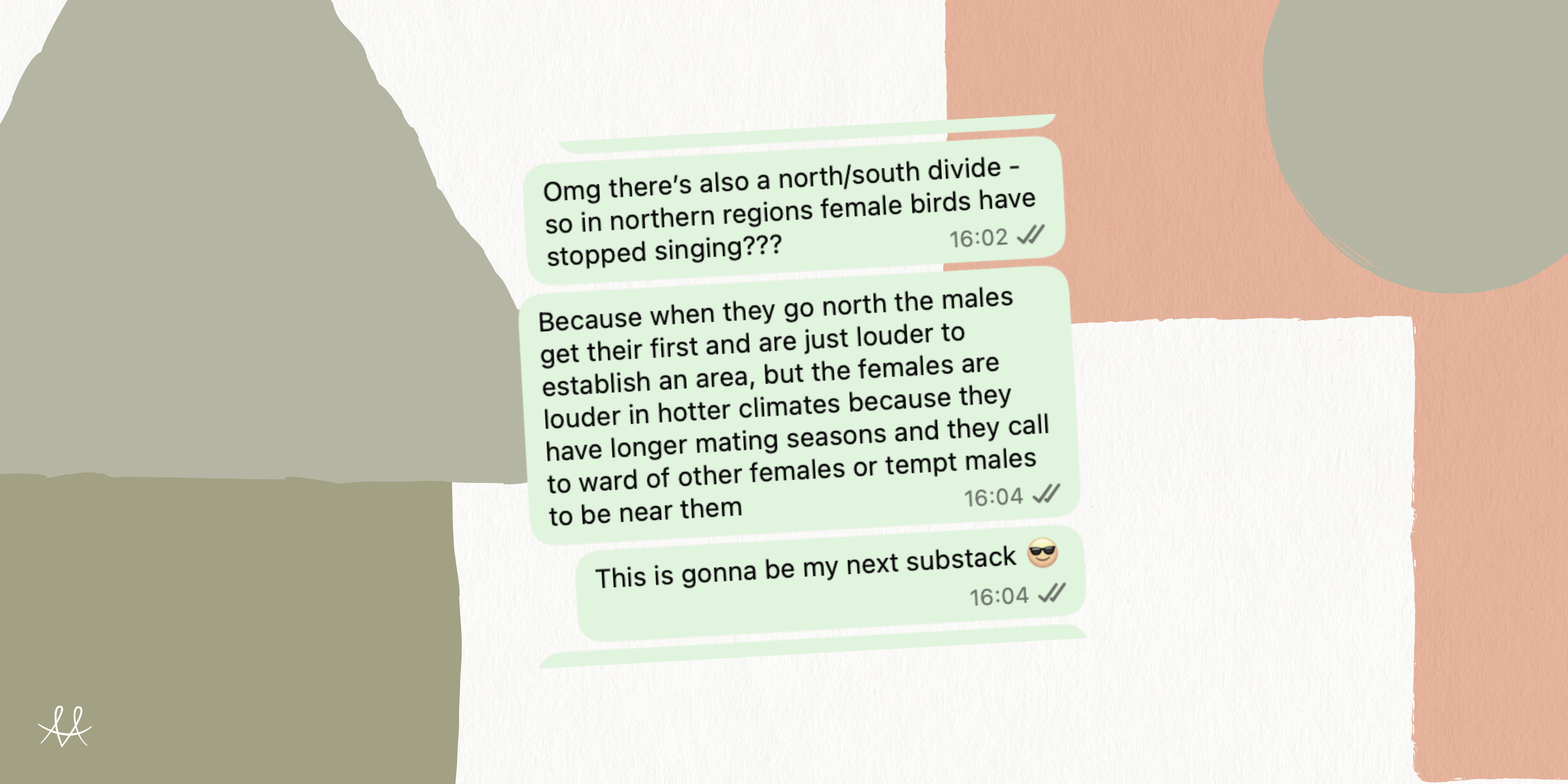
Let me explain it properly, because the real version is better than my wild texting.
A lot of the birds that European and North American scientists studied are migrants. They fly south for winter, then race back north in spring to breed. In that setup the breeding season is short and frantic, the pairs form for a single summer, and then everyone scatters again. There is less call, evolutionarily speaking, for a female to hold ground with her voice year after year, because there is no year-round ground to hold and no long-term partner to hold it with. The research tells us that the gains of migration tend to go hand in hand with losses of female song.
Now go to the tropics, or to resident species that stay put. Birds there often defend the same territory all year, in stable, long-term partnerships. A female with a permanent stake in a permanent patch has every reason to sing: to see off rival females, to defend the resources she needs, to hold her place. So female song is common in resident, territorial species pretty much wherever they live, and comparatively rare in migrants.
Migration seems to relax the pressure that keeps female song around. Lose the year-round territory and the long-term pair bond, and female song tends to fade out of the lineage over evolutionary time.
I want to flag one thing my texts got slightly wrong, because I got excited and ran ahead of the science. I told my friend it was about heat and longer mating seasons making females “louder.” It is more accurate to say it is about staying put and defending a territory all year, which happens to correlate with warmer, more stable climates rather than being caused by the warmth itself. One big comparative study found that females singing together with their mates lined up most strongly with year-round territoriality, and specifically not with latitude or climate on their own. So: residency is the engine. Climate is just along for the ride. I stand corrected by my own rabbit hole.
But it’s about people too.
The science was standing in the wrong place
Most of the foundational birdsong research was done in the northern temperate world. Britain, Europe, North America. The places where the universities were, where the funding was, where the famous naturalists happened to live and look out of their windows.
And those happen to be exactly the places where female song genuinely is less common, because those are the migrant strongholds.
So the field looked out at its local birds, saw mostly silent females, and quietly generalised that to all birds everywhere. The textbook definition of song got built around male singers because, in the specific postcode where the textbooks were written, the loudest singers usually were male. A regional quirk got promoted to a universal law. The tropics, where females sing all year and nobody finds it remarkable, were filed under “innumerable exceptions.”
This is the bit that should make any bird loving intersectional feminist grin somewhat angry. The blind spot was also about geography, about whose backyard counts as the default and whose gets to be the exception. A handful of cold northern countries decided what “normal” bird behaviour was, decided it was a fact, and the singing females of half the planet got written off. The science was sexist and provincial, and the two biases held hands and reinforced each other for a hundred years.
You cannot study the whole world from one cold corner of it and call your local weather the climate. But that is more or less what happened.
Even the famous birds were hiding it…
If you think this is all safely in the past, let me introduce the blue tit.
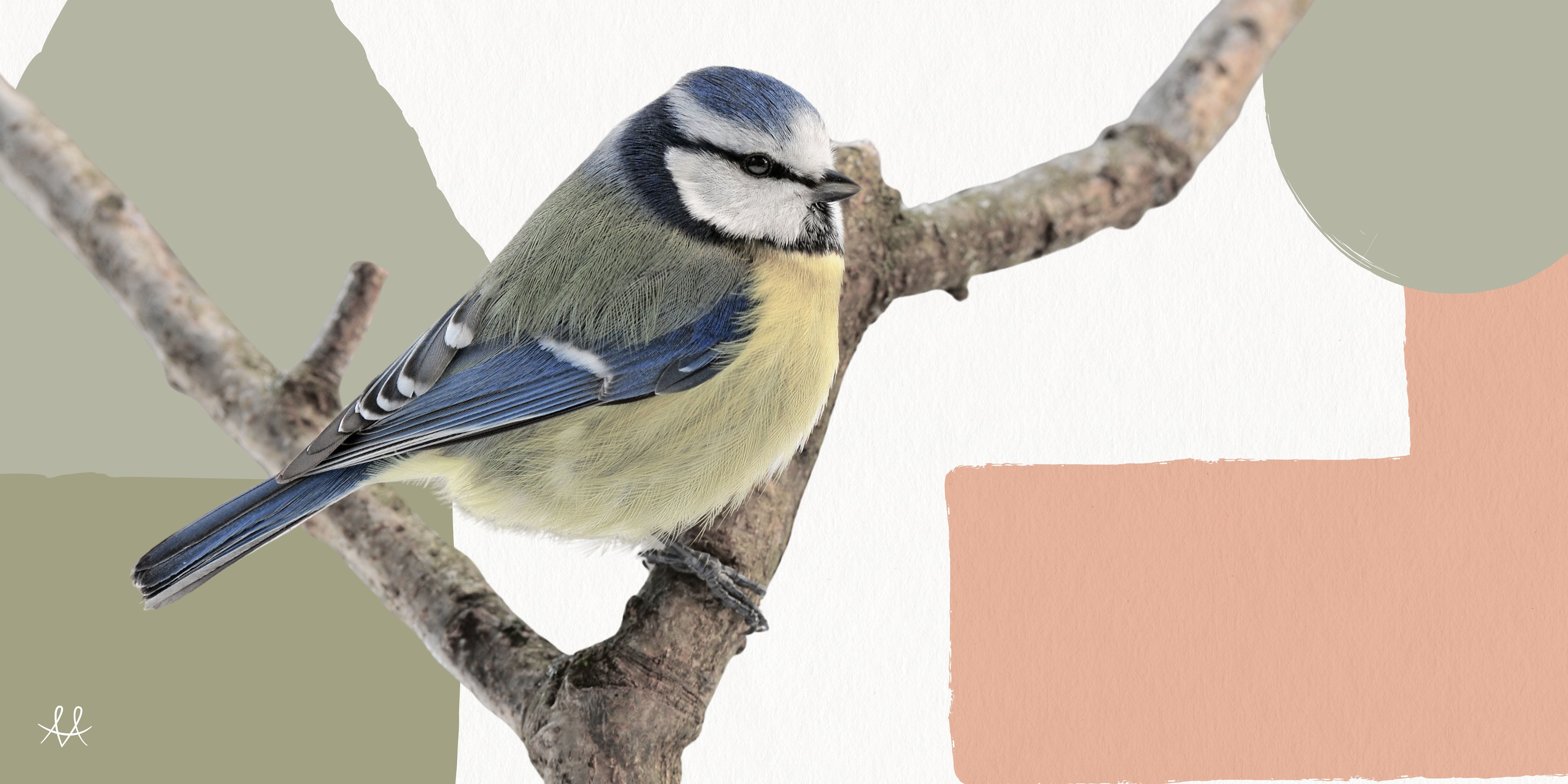
The blue tit is one of the most studied birds in the entire northern hemisphere. It is a model species, basically the lab rat of European ornithology, watched by thousands of researchers for decades. Generations of scientists have stared at blue tits.
And until a 2022 study went looking specifically, the recorded evidence that female blue tits sing amounted to a handful of anecdotes. Then someone actually listened, on purpose, and found the females singing frequently, in the alarm context, structured a lot like the males’ song but with their own patterns. Hiding in plain sight, in one of the best-watched birds on Earth, for the entire history of the discipline.
It was never that the females were quiet. It was that nobody had decided their voices were worth listening to.
I’m angry for the birds.
I went into this expecting a tidy fact about birds. I came out with something closer to yet another parable about how knowledge gets made.
The female birds were singing the whole time. The science just had a definition that couldn’t hear them, written by people in a part of the world where the silence happened to fit their theory, and propped up by the conveniently scientific-sounding idea that any female who broke the pattern was simply hormonal. Wrong on the birds. Wrong, in a quietly familiar way, on the assumptions underneath. It’s gendered language again, but the language is tweeting.
I think that is the most feminist thing about it. Not the birds, lovely as they are. The reminder that “we’ve never seen it” and “it isn’t there” are not the same sentence, no matter how many decades or textbooks insist otherwise.
Anyway. I’m thinking about birds a lot now. Somewhere out there a female is singing, and has been all along, and the only thing that has changed is that a few people finally wrote it down.
If you want to fall down the same hole:
Lucy Cooke, Bitch: A Revolutionary Guide to Sex, Evolution and the Female Animal (2022). The book that started it for me.
N. E. Langmore, “Functions of duet and solo songs of female birds,” Trends in Ecology & Evolution (1998). Where the “functionless aberration” line lives.
Austin, Dalziell, Langmore & Welbergen, “Avian vocalisations: the female perspective,” Biological Reviews (2021). The big modern synthesis.
Hall & Langmore, “Fitness Costs and Benefits of Female Song,” Frontiers in Ecology and Evolution (2017). On why some females lost song.
Langmore, “Female song can be over-looked in even the most intensively studied songbirds,” Behavioral Ecology (2023). The blue tit reckoning.
Cain & Langmore, “Female and male song rates across breeding stage,” Animal Behaviour (2015). Fairy-wrens and female-female competition.
I’m going to be using male/female here because we’re talking about biological sex, not gender.