

Does “Banter” Avoid Accountability?
And is it Linguistic Gaslighting?
“It’s just banter, mate.”
Little words that can transform racism into playground fun, bullying into bonding, and harm into humour; “just banter”. This week, Nigel Farage demonstrated exactly why this linguistic sleight of hand is so dangerous when he dismissed allegations of racist and antisemitic remarks from his school days as “banter in a playground”.
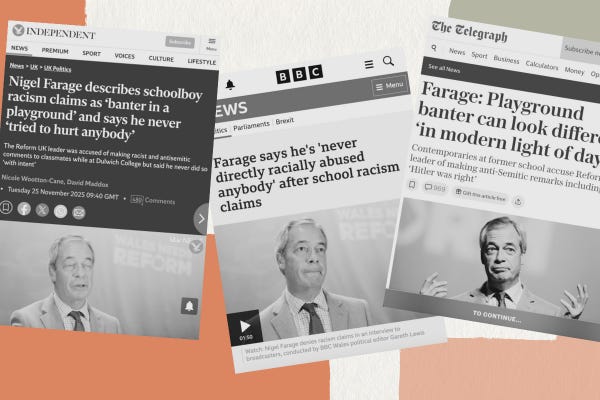
The Ground News summary (a platform I genuinely love for its bias comparison features and transparency about media funding - you can get 40% off with my affiliate link) reveals something quite scary: over 20 former classmates remember specific incidents of racial abuse, including alleged comments about Hitler and gas chambers. And Farage’s response? He’s “never directly racially abused anybody” - with the word “directly” doing a lot of heavy lifting.
I’ve been deep in research about banter lately for an exciting project I can’t announce yet (ahhhh), and what keeps coming up is how this single word operates as a retroactive permission slip. The linguistic and cognitive practices surrounding “banter” are so interesting; banter requires all participants to recognise it as playful, to be “in on the joke.” But who decides when everyone’s in? Usually, the person with the most power in the room.
Last week, my therapist and I spoke about the importance of rupture and repair work (how relationships that face difficulty can come out stronger). In healthy relationships, playful insults between equals can create small ruptures that, when immediately repaired through laughter, affection, or reciprocal teasing, actually strengthen bonds. This psychological framework helps explain why genuine banter between close friends can feel affirming (the micro-cycle of rupture and repair reinforces trust and intimacy). But this only works when there’s an established relationship, mutual consent, and immediate repair. Generic hate speech or bullying involves no repair, no relationship, no consent. Just rupture. When Farage retrospectively labels alleged racist comments as “banter,” he’s trying to claim the social license of rupture-repair dynamics without any of the essential ingredients: the relationship, the repair, or the other person’s agreement that this was ever playful. It’s like claiming you were just “play fighting” after punching a stranger right in the face. With a shovel.
The research shows banter and gossip serve remarkably similar social functions - building in-group solidarity, establishing hierarchies, marking boundaries. But aggressive masculine “banter” gets celebrated as team building while gossip gets vilified. Professional kitchens normalise verbal abuse as essential bonding. Schools struggle with students who weaponise “it’s just banter” to deflect from racist and sexist behaviour. The pattern is so so obvious. Those in positions of power get to define what counts as harmful.
What makes Farage’s framing dangerous (in my opinion) is how it rewrites history through linguistic framing. We know the power of words, but this shows how they can be used to normalise hate speech. Those alleged Hitler comments? Suddenly they’re just “things 50 years ago that you could interpret as being banter”. The students who felt targeted? They’re reimagined as political opponents with conveniently selective memories. The harm itself? Disappeared entirely, because real banter (by definition) can’t be harmful.
And this goes beyond one politician having a selective memory. When public figures model this defensive manoeuvre, it teaches and normalises a culture of accountability avoidance. Young people absorbing these messages learn that adding “just joking” or “it’s banter” to cruel words creates a magic shield, a pattern still seen in schools now according to my friends who are teachers. Those who object get labeled as oversensitive, not having a sense of humour, and unable to take a joke.
Teenagers in recent studies articulated this brilliantly, by sharing that real banter is “something that both people find funny”. But achieving this mutual understanding requires sophisticated social awareness, cultural alignment, and (critically) relatively equal power dynamics. Without these elements, “banter” becomes a one-way street where the powerful get to define reality for everyone else.
Language shapes how we understand behaviour. When we allow “banter” to become a universal excuse, we’re actively choosing whose pain matters and whose doesn’t. The loudest voices shouldn’t get to diminish others’ experiences simply by labelling them as “banter”. Racist comments are just racist comments, no matter what linguistic label we dress them in.